
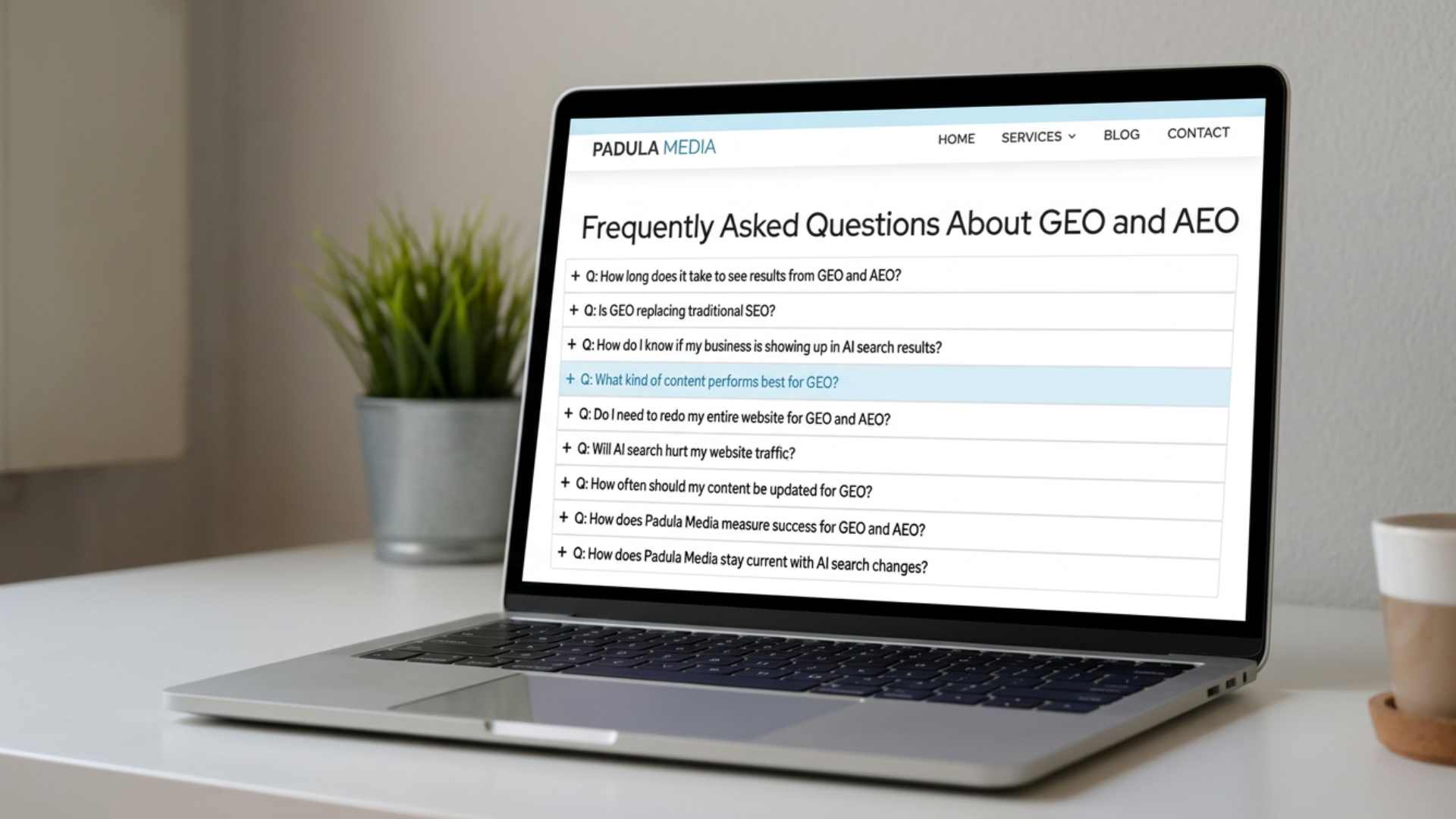
FAQs help with AEO by turning real customer questions into clear, direct answers that search engines and AI tools can understand and use more easily.
When your website answers these common questions in a structured, organized way, it gives answer engines better content to pull from and recommend to potential customers online. This is a big win for any small business trying to edge out competition in the age of AI search.
As answer engine optimization specialists, we see FAQs as one of the simplest ways to make your web pages more useful to people and more readable for AI tools. A good FAQ section can also support traditional SEO and help customers feel more confident before they contact you, making it a tool you shouldn’t ignore.
First: What Is AEO?
AEO is answer engine optimization, the process of structuring your website so that it can show up more effectively in search experiences like Google’s AI overviews.
Traditional SEO (search engine optimization) focuses on building up visibility in standard search results. AEO builds on your SEO strategy by helping your content answer specific questions that can easily be cited in AI-generated answers.
AEO Is All About Quick, Clear Answers
Answer engines are built to give near-instant answers to practical questions. That means for your content to be cited by them, it needs to be easy for them to interpret.
This is how FAQs help with AEO, as they are often cited by answer engines like Google’s widely-used AI overviews. They naturally use a question-and-answer format, which matches how people search and how AI tools organize information.
Why Should Your Pages Have FAQs?
FAQs give your website extra opportunities to answer questions about your products and services that will potentially show up in AI-generated search results.
Each FAQ gives your site another shot at answering a real question, instead of just relying on your long-form copy to end up in organic search results. This tactic lets you break up important information into smaller, easier-to-scan sections.
FAQs Create Extractable Content
AEO works best when the answer to a user’s question is easy to extract from your site.
A long paragraph can give a potential customer helpful info, but it may also cover multiple topics at once. An FAQ answer is usually more focused and specific, which sets up the context for answer engines to extract and cite.
Since AI overview citations show up to the right of the overview as clickable links, this points more users straight to your site.
FAQs Improve the User Experience
In addition to priming answer engines to extract content from your site, FAQs also make your pages easier to navigate for humans.
Customers often have key questions before they call or click, and if your website answers those questions clearly on each relevant page, visitors are much more likely to stay engaged.
Where Should FAQs Go on Your Website?
FAQs should go on the pages where customers are most likely to have questions.
In general, that means your homepage, service pages, location pages, product pages, and, sometimes, blog posts. You can also create a dedicated FAQ page if you expect your audience to ask a wide range of general questions.
Add FAQs to Your Homepage
Having a basic FAQ section near the bottom of your homepage can play a helpful part in your AEO strategy. This section can answer the most common questions about your company, your work, and how to get started with your products or services.
Add FAQs to Service Pages
For SEO, your site should include a dedicated page for every core service you offer. Each of these pages should, in most cases, also have its own FAQ section.
For example, if you run an emergency plumbing company that serves commercial and residential properties, you’ll need a commercial services and residential services page, each with FAQs. These questions could include:
- How long do you take to respond to service requests?
- Can you fix plumbing problems in apartment buildings?
- Do you have an emergency plumbing hotline?
Adding these types of questions and answers will give each page a better chance of being cited in AI overviews on Google. It will also help customers feel decisive about calling you when they read your pages.
Add FAQs to Location Pages
Another core SEO strategy for small businesses is creating detailed, unique pages for each location in your overall service area. For businesses that operate solely online, this isn’t a factor, but for anyone with a brick-and-mortar building or physical service area, it matters for your local SEO strategy.
These pages should also have FAQ sections. You can answer questions like:
- What parts of this service area will you work in?
- Do you have a physical location in this service area?
- What number do I call to reach your office in this service area?
These questions can help you get cited for searches directly related to your business (branded queries), but they may also give you a boost for high-intent non-branded traffic (queries like “emergency plumber near me”).
How Do You Write FAQ Sections for AEO?
The best FAQ sections are based on real questions that customers have asked in the past.
Base the questions in your FAQs on questions you get regularly on sales calls, in contact forms, and on search engines. A digital marketing agency that specializes in AEO can help you carefully analyze Google Search Console data to see what potential customers are asking across the web, and these questions can make your FAQ sections more effective than ever.
Use FAQs To Connect Where Customers Are Searching
FAQs help with AEO because they make your website more answer-ready. They directly reflect how people search and give answer engines like Google’s AI overviews clearer content to add to responses.
At Padula Media, we help businesses create content built for the age of AI search. We specialize in SEO and AEO for small businesses, and we’re here to help your business show up where potential customers are searching now.
If you’re ready to turn marketing confusion into predictable growth, schedule a call with our AEO team today.